Agentic AI’s Economic Impact: Reshaping Industries & Growth in the Agentic AI Economy
Artificial intelligence is projected to add over $15 trillion to the global economy by 2030. A significant portion of this growth will come from a new frontier: agentic AI. Unlike earlier AI that simply analyzed data, these autonomous systems can plan, reason, and execute complex tasks on their own. They function less like tools and more like skilled digital team members, profoundly influencing the economic impact of AI.
This evolution from passive to active AI creates a profound shift for businesses, demanding a new strategic playbook. The emerging agentic AI economy will reshape marketing, sales, and human resources, driving significant AI workforce transformation. To help you navigate this landscape, we’ll break down the economic impact of AI, highlight key opportunities for autonomous AI growth, and provide a clear framework for adapting your business to thrive in the future of work AI.

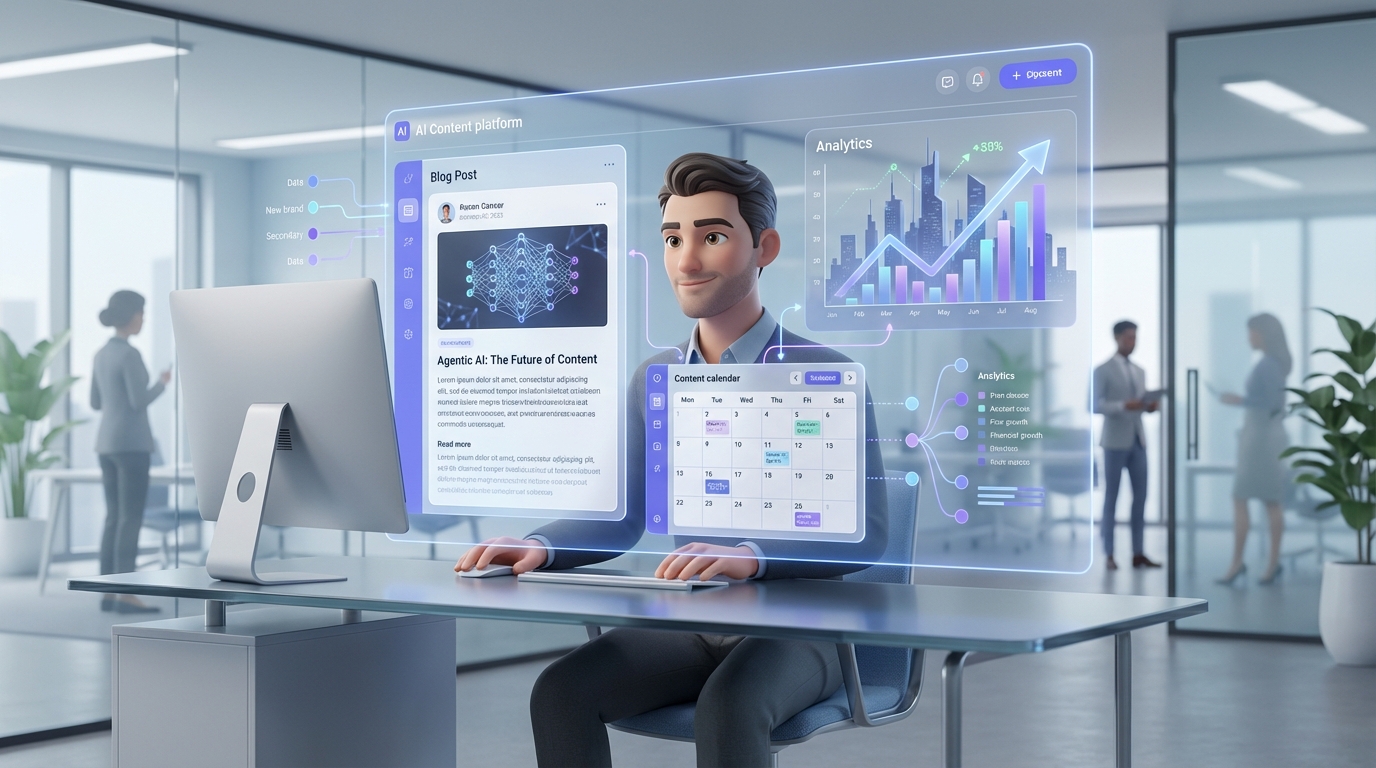
Unlocking new frontiers of productivity: Agentic AI, your autonomous digital strategist, seamlessly integrating planning and reasoning into the heart of your team.
The Trillion-Dollar Shift: Understanding Agentic AI’s Economic Impact
That projected $15 trillion economic boost isn’t just about faster computers. It’s driven by a fundamental change in how work gets done. The economic impact of AI accelerates dramatically with autonomous systems. Agentic AI moves beyond simple task automation to tackle entire complex workflows, creating value in ways previous technologies could not, thus fueling the agentic AI economy.
This shift creates three primary economic drivers:
-
Exponential Productivity: Autonomous agents manage entire projects. An AI can run a full content marketing campaign, from topic research with MarketDay to performance analysis. This frees human teams for high-level strategy, contributing to overall autonomous AI growth.
-
New Market Creation: Agentic AI can analyze vast datasets to identify and act on untapped market opportunities. It can create and manage new sales funnels or service lines with minimal human oversight, driving significant autonomous AI growth and expanding the agentic AI economy.
-
Drastic Cost Reduction: Automating entire business functions, like recruitment or sales outreach, significantly lowers operational costs. According to McKinsey, generative AI has the potential to add the equivalent of $4.4 trillion to the global economy annually, further demonstrating the positive economic impact of AI.
The difference between traditional and agentic AI highlights this new economic reality.
CapabilityTraditional AI (Analytic)Agentic AI (Autonomous)Task ScopeAnalyzes data, answers queriesPlans and executes multi-step projectsEconomic RoleCost-saving tool, decision supportGrowth engine, new revenue creatorHuman InteractionRequires constant human directionOperates independently, reports resultsExampleA chatbot answering FAQsAn AI managing a full sales pipeline
This AI workforce transformation redefines roles. It elevates employees from task-doers to strategic supervisors of digital agents. The businesses that understand this shift will capture the lion’s share of the emerging agentic AI economy. They won’t just be more efficient; they will operate on a completely new level, shaping the future of work AI.
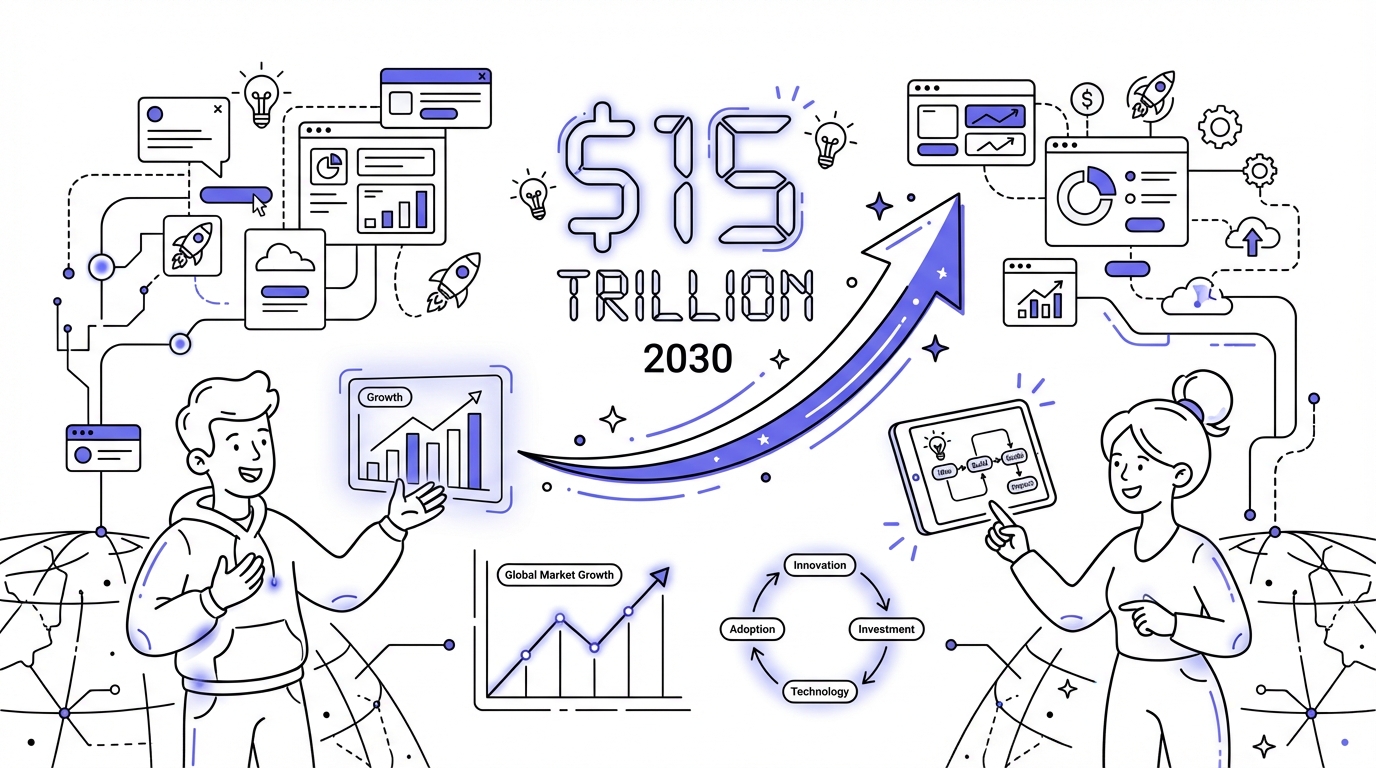
Projected to inject $15 Trillion into the global economy by 2030, this infographic highlights the significant impact of upcoming economic growth.
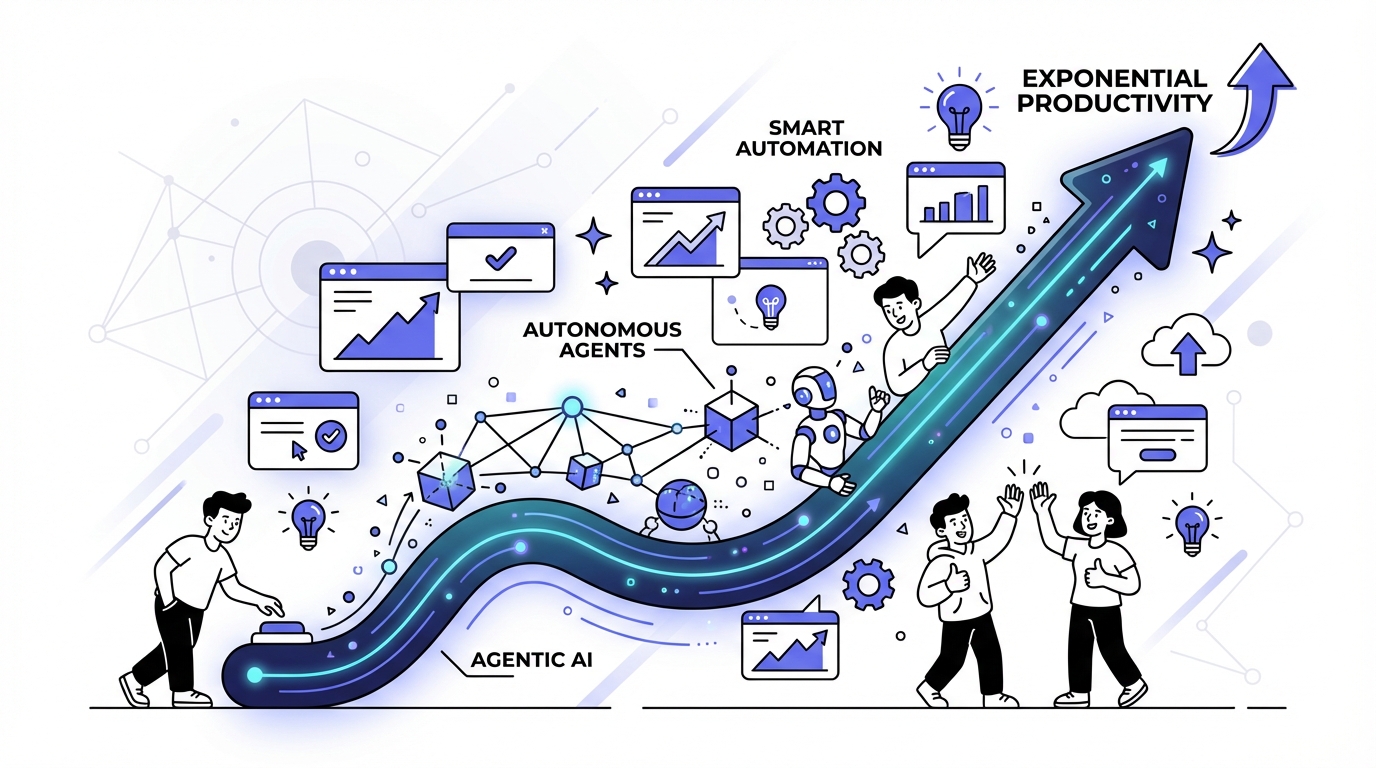
Illustrating ‘Exponential Productivity,’ a key economic driver where agentic AI autonomously generates accelerating output and value, propelling unprecedented growth.
From Generative to Agentic: Driving Autonomous AI Growth
Most businesses are familiar with generative AI. It’s a powerful tool for creating marketing copy, code, or images based on specific prompts. This technology is reactive. It requires a human operator to direct every single step of a process. The real transformation begins when we move from reactive tools to autonomous agents, driving profound autonomous AI growth.
Think of generative AI as an expert specialist. You assign a specific task, and it delivers a high-quality result. An agentic system acts more like a department head. You provide a broad objective, and it formulates a plan, delegates tasks, and executes the entire project. This is the core of the AI workforce transformation and a key aspect of the future of work AI.
A Practical Example: Content Creation
The difference becomes clear in a common business workflow.
-
With Generative AI: A marketer prompts an AI to write a blog post. They then prompt it again to create social media captions. Next, they ask a different AI to generate an image. The marketer manually assembles and publishes everything.
-
With Agentic AI: A marketer sets one goal: “Launch a content campaign for our new feature.” The agent researches the topic, writes the article using a platform like MarketDay, generates visuals, drafts and schedules social posts, and tracks initial performance.
Shifting from manual prompting to goal-oriented execution drives autonomous AI growth. It’s not just about improving efficiency; it’s about creating capacity for strategic initiatives that were previously impossible. A recent report from Andreessen Horowitz (a16z) suggests these systems could automate up to 65% of enterprise tasks, defining the new agentic AI economy and its substantial economic impact of AI.
AI Workforce Transformation: Jobs, Skills, and Human-AI Collaboration
The rise of autonomous agents naturally raises questions about jobs. The narrative, however, isn’t about replacement. It’s about redefinition. The AI workforce transformation elevates human talent from performing repetitive tasks to directing strategic outcomes. Your team’s value shifts from doing the work to defining what work gets done, fundamentally altering the future of work AI.
From Task Execution to Strategic Oversight
Think of your employees as conductors of an AI orchestra. They don’t play every instrument. Instead, they guide a team of specialized agents to create a cohesive result. A marketing manager no longer writes every social media post. They set a campaign goal, direct an AI agent to execute it, and then analyze the results to refine future strategy.
This new model lets your team focus on where they matter most: creativity, critical thinking, and customer relationships. The future of work AI is collaborative—you provide the vision, and AI provides the velocity. It’s this partnership that truly underpins autonomous AI growth and the evolving agentic AI economy.
Essential Skills for the Agentic AI Economy
Adapting to the agentic AI economy requires a new set of professional skills. Technical proficiency becomes less about manual execution and more about strategic direction. Success now depends on your team’s ability to:
-
Define clear, high-level business objectives for AI agents.
-
Critically evaluate AI-generated outputs and strategies.
-
Integrate AI insights into broader company goals.
-
Foster creative solutions that AI alone cannot conceive.
The AI workforce transformation demands these new competencies. The shift is clear. According to Gartner, AI-driven decision support will soon be a critical competency for over a third of all large enterprises. Value moves from manual labor to the intellectual framework that guides the AI, defining the future of work AI.
Role FocusLegacy Skill (Manual)Agentic-Era Skill (Strategic)MarketingWriting individual blog postsDesigning a 6-month content strategy for an AISalesSending 100 cold emails dailyOptimizing an AI agent’s outreach parametersRecruitingScreening 200 resumesDefining ideal candidate profiles for an AI sourcer
Businesses that invest in upskilling their teams for these strategic roles will not just compete. They will lead the market in this AI workforce transformation.
Maximizing ROI: Agentic AI’s Operational Transformation for Economic Impact
The shift to strategic oversight creates tangible business results. Agentic AI moves beyond simple task automation. It re-engineers entire operational workflows for maximum efficiency, directly impacting your bottom line. This isn’t just about doing things faster. It’s about creating systems that learn, adapt, and operate with a business goal in mind, showcasing the profound economic impact of AI.
From Manual Workflows to Autonomous Systems
The result? Core business functions are completely reshaped. What once required dozens of manual hours can now be managed by a single, goal-oriented agent. The economic impact of AI is most visible here, where operational capacity expands without a proportional increase in costs, driving significant autonomous AI growth within the agentic AI economy.
-
Marketing: An agent using a platform like MarketDay can run an entire content campaign. It researches keywords, writes articles, generates images, and analyzes performance data to optimize future content, illustrating the future of work AI in marketing.
-
Sales: An autonomous agent manages lead nurturing. It sends personalized follow-ups, schedules meetings based on prospect activity, and hands off qualified leads to human account executives, a clear example of AI workforce transformation.
-
Recruiting: An AI agent sources candidates across multiple platforms, conducts initial screenings against job criteria, and schedules interviews with the most promising applicants.
This level of automation creates a significant advantage. A recent study by McKinsey highlights that AI-powered functions can boost productivity by up to 40%, freeing human teams to focus on high-value strategic work, further accelerating autonomous AI growth and solidifying the agentic AI economy.
The Agentic Sales Outreach Model
The difference in operational output is stark. A human salesperson is limited by time. An AI agent is limited only by its defined parameters. This is a core driver of autonomous AI growth within an organization, showcasing the true economic impact of AI.
TaskTraditional Approach (Manual)Agentic Approach (Autonomous)ProspectingManually searching LinkedIn for 2 hoursContinuously scanning data sources for ideal profilesOutreachSending 50-100 templated emails per daySending 1,000+ personalized emails based on triggersFollow-upTracking responses in a CRMAutomatically adjusting follow-up cadence by engagementReportingCompiling weekly activity reportsProviding a real-time dashboard of campaign ROI
These examples show a fundamental change in how work gets done. Operations are no longer a checklist of human tasks. They are integrated, intelligent systems guided by human strategy. Businesses that adopt this model will find their resources freed for innovation, growth, and building a decisive market advantage in the agentic AI economy.
Strategic Adoption for the Agentic AI Economy: Sustainable Growth
Understanding the potential of agentic AI is one thing. Capturing its value requires a deliberate strategy. Simply buying a new tool for an old process yields limited returns. True transformation comes from redesigning workflows around autonomous capabilities to achieve sustainable growth in the agentic AI economy.
From Tactical Tools to Strategic Integration
Many companies adopt AI tactically. They buy a tool to solve one specific problem. A strategic approach, however, builds an integrated system where AI enhances entire business functions. This mindset is critical to capturing a share of the economic impact of AI, which PwC estimates could add $15.7 trillion to the global economy by 2030, fundamentally reshaping the future of work AI.
AspectTactical Adoption (Siloed)Strategic Adoption (Integrated)GoalSolve an immediate pain pointBuild a long-term competitive advantageMeasurementTask completion speedOverall impact on revenue and costsImplementationIsolated department useCross-functional workflow integrationTeam FocusLearning to operate a new toolUpskilling for strategic AI oversight
This strategic approach is vital for navigating the AI workforce transformation effectively.
Building an Autonomous Foundation for Autonomous AI Growth
Success in the agentic AI economy depends on creating a cohesive operational framework. This means selecting platforms that not only perform tasks but also connect with your core business data and systems, ensuring sustained autonomous AI growth.
An autonomous content platform like MarketDay, for example, is most powerful when connected to your central knowledge base. It doesn’t just write a blog post. It writes a post that reflects your company’s unique expertise and data, driving more qualified traffic. This integrated approach ensures that AI efforts are aligned with core business objectives, maximizing the economic impact of AI.
The goal is not to collect a series of disconnected AI tools. The businesses that build an integrated, intelligent foundation today are the ones that will define their markets tomorrow.
The move from generative to agentic AI represents more than a technological update. It’s a fundamental economic restructuring, driving a profound AI workforce transformation. This evolution redefines workforce collaboration and creates new pathways for substantial operational ROI, shaping the future of work AI. The key isn’t just acknowledging the trillion-dollar potential of the economic impact of AI; it’s acting on it with a clear strategy to foster autonomous AI growth within the emerging agentic AI economy.
Your company’s future growth now hinges on this adaptation. Integrating intelligent automation to handle complex, goal-oriented processes is the most critical next step. This is how businesses will secure their position in the agentic AI economy we are all entering, ensuring continued autonomous AI growth. The advantage will go to those who build, and automate, intelligently, embracing the true economic impact of AI and the future of work AI.
Put agentic AI to work for your business. See how MarketDay can autonomously build your content engine to drive traffic and growth in the agentic AI economy.
Frequently Asked Questions
What is the Agentic AI economy?
The **Agentic AI economy** describes an emerging economic landscape driven by autonomous AI systems. Unlike traditional AI, these agents can plan, reason, and execute complex tasks independently, acting as digital team members. This profound shift influences the **economic impact of AI** by reshaping industries like marketing, sales, and HR, demanding new strategic approaches from businesses.
How will the Agentic AI economy impact global growth?
The **Agentic AI economy** is projected to add over $15 trillion to the global economy by 2030. This growth stems from autonomous systems accelerating the **economic impact of AI** through exponential productivity, new market creation, and drastic cost reduction. These agents manage entire projects and identify untapped opportunities, driving significant **autonomous AI growth** across various sectors.
What key drivers fuel autonomous AI growth within the Agentic AI economy?
**Autonomous AI growth** in the **Agentic AI economy** is fueled by three primary drivers. First, exponential productivity, as agents manage entire projects like content campaigns. Second, new market creation, where AI identifies and acts on untapped opportunities. Third, drastic cost reduction, achieved by automating entire business functions such as recruitment or sales outreach, significantly boosting the **economic impact of AI**.
How does Agentic AI lead to AI workforce transformation?
**Agentic AI** drives significant **AI workforce transformation** by redefining human roles. Instead of performing routine tasks, employees will transition to strategic supervisors of digital agents. This shift elevates the workforce, allowing humans to focus on high-level strategy and creativity. Businesses adapting to this change will thrive in the evolving **future of work AI**, operating at a new level of efficiency and innovation.
What is the difference between traditional AI and Agentic AI in the Agentic AI economy?
In the **Agentic AI economy**, traditional AI primarily analyzes data and requires constant human direction, serving as a cost-saving tool. In contrast, **Agentic AI** plans and executes multi-step projects autonomously, functioning as a growth engine and new revenue creator. This fundamental difference dramatically accelerates the positive **economic impact of AI**, allowing systems to operate independently and report results.
What is the projected economic impact of AI, specifically Agentic AI, by 2030?
The **economic impact of AI**, particularly from agentic systems, is projected to add over $15 trillion to the global economy by 2030. This substantial growth is driven by agentic AI’s ability to move beyond simple task automation to manage complex workflows autonomously. This fuels the emerging **Agentic AI economy** by creating value in unprecedented ways and significantly boosting productivity across industries.
How does the future of work AI involve a shift from generative to agentic systems?
The **future of work AI** involves a crucial shift from reactive generative AI to proactive agentic systems. Generative AI requires human operators for each step, acting as a specialist tool. Agentic systems, however, function like department heads, formulating plans and executing entire projects autonomously. This transformation drives profound **AI workforce transformation**, enabling businesses to operate with greater independence and strategic oversight.
Leave a Reply